
Strategy vs. Execution: Why doing more isn't the same as doing it right
You're publishing content, running ads, posting on LinkedIn, sending emails. You're doing a lot. So, why isn't your pipeline growing? Because in B2B tech marketing, activity is not the same as momentum and more is not the same as better.
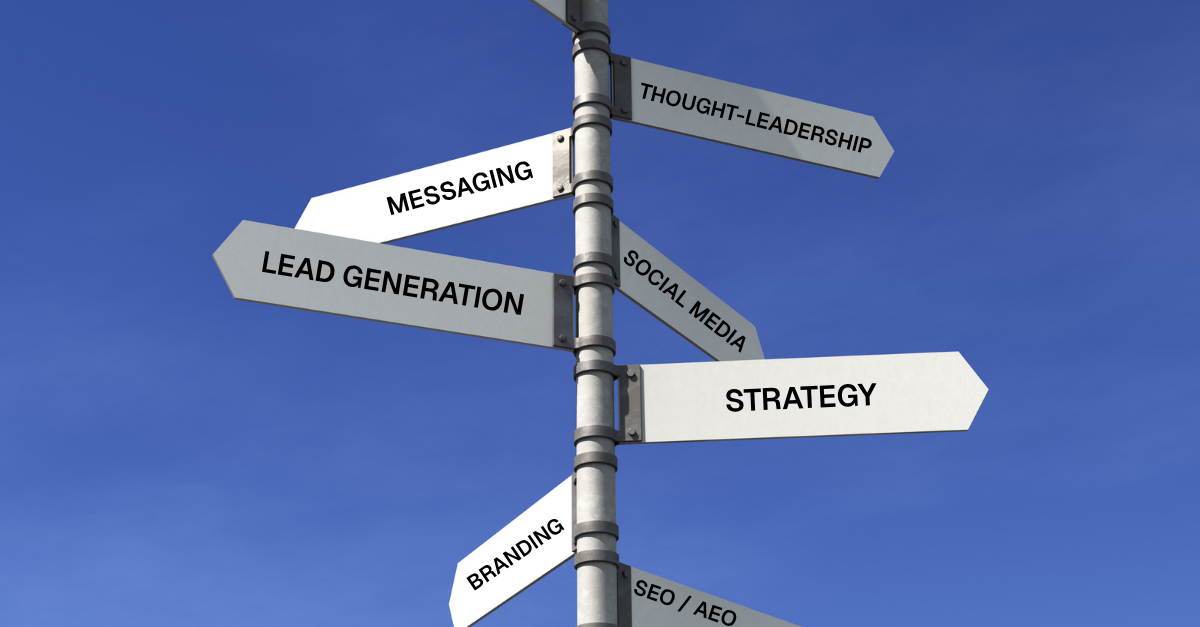
What is the difference between marketing strategy & execution?
Marketing strategy defines who you're targeting, what you stand for, how you're positioned in the market, and what goals your marketing should achieve. It answers the questions: Who are we talking to? What do we want them to believe? And, where do we focus our efforts? Marketing execution is everything that follows once the strategy has been established: the campaigns, the content, the ads, the emails, the social posts, the events. It's the doing. It answers: What are we producing, on which channels, in which formats, and how often? Both are essential; neither works without the other.
STRATEGY = THE WHY & WHO
- ICP and buyer persona definition
- Market positioning and differentiation
- Messaging architecture
- Channel selection rationale
- Goals, KPIs, and measurement framework
- Buyer journey mapping
STRATEGY = THE WHY & WHO
- ICP and buyer persona definition
- Market positioning and differentiation
- Messaging architecture
- Channel selection rationale
- Goals, KPIs, and measurement framework
- Buyer journey mapping
STRATEGY = THE WHY & WHO
- ICP and buyer persona definition
- Market positioning and differentiation
- Messaging architecture
- Channel selection rationale
- Goals, KPIs, and measurement framework
- Buyer journey mapping
Strategy without execution is a document that collects dust. Execution without strategy is like navigation without a destination, wasting your valuable marketing budget and leading to frustration. You might be moving fast, but you have no idea whether you're getting closer to where you need to go.

"Execution without strategy is like navigation without a destination. You might be moving fast, but you have no idea whether you're getting closer to where you need to go."
ButtonWhy busy marketing doesn't mean effective marketing.
There's a trap that catches nearly every B2B tech company at some point. We call it the activity trap. It's the mistaken belief that more marketing activity will eventually produce more results, regardless of direction or coherence.
It shows up in recognizable ways: a company publishing three blog posts a week but seeing no meaningful increase in qualified traffic. Running LinkedIn ads with no clear audience segmentation and wondering why lead quality is poor. Sending monthly email newsletters to a list that's never been segmented or cleaned, and getting open rates in the single digits.
B2B tech companies are particularly vulnerable to this trap. Here's why:
Tech companies are product-led by default. The founders and leadership team are typically engineers, scientists, or domain experts. They understand the product deeply. Marketing, in their mental model, is often reduced to "getting the word out." So, they start producing output and confuse that output with progress.
Marketing hires often come after the problem is already visible.
By the time a first marketer or agency is brought on, there are already entrenched habits: inconsistent messaging, a website written for technical peers rather than buyers, content that explains features rather than addressing customer pain.
The pressure to show activity creates a cycle. Leadership wants to see marketing "doing things." Marketers respond by producing things to demonstrate effort. The result is a volume of output that's disconnected from any strategic intent.
Real Scenario
Consider a 40-person B2B SaaS company in the telecom space. They have an active blog, a LinkedIn page, and a monthly newsletter. The sales team complains that leads are low-quality. The CEO wonders why "all this marketing" isn't working. The problem? Content was written to impress technical peers but not to educate non-technical, business decision makers. The LinkedIn posts were recycled product updates, not thought leadership. There was no defined ICP, no messaging hierarchy, no nurturing sequence. There was execution, just not in service of any coherent marketing strategy.
5 signs your marketing lacks a strategy.
These are the most common red flags we see when working with B2B tech companies for the first time. If several of these are familiar, your execution problem is actually a strategy problem in disguise.
1. Your messaging changes depending on who is presenting.
If your CEO pitches the company differently than your sales lead, and your website says something else entirely, you don't have a positioning problem, you have a strategy problem. Consistent messaging starts with deliberate choices about what you stand for and for whom.
2. You're targeting everyone and converting no one.
When your ICP is "any company that could benefit from our solution," your marketing becomes generic by default. Precision in targeting such as by industry, company size, role, pain point, or buying stage is a strategic decision that makes every downstream execution effort more effective.
3. Marketing and sales aren't aligned on the buyer journey.
Sales thinks marketing sends them unqualified leads. Marketing thinks sales doesn't follow up. In the middle: no agreed-upon definition of what a qualified lead looks like, no mapped buyer journey, no handoff protocol. This is a structural gap that only strategy can fix.
4. You can't explain why you chose your marketing channels.
Are you on LinkedIn because your buyers are there, or because everyone else in your industry is? Did you start a podcast because it fits your go-to-market motion, or because a competitor did? Channel selection should be a strategic decision rooted in buyer behavior, not imitation or impulse.
5. You have no framework for measuring what's working.
If your marketing report is a list of activities rather than outcomes (e.g., posts published, emails sent, ads running, etc.) you're measuring effort, not impact. A strategy defines the metrics that matter and connects marketing actions to business results.
5 signs your strategy is not being executed.
The flip side is equally common and equally damaging. Some companies invest in building a solid strategy, then fail to bring it to life. The strategy document exists. The execution doesn't follow.
1. The strategy deck was approved and then shelved.
Strategy that lives in a slide deck and never gets operationalized is not a strategy, it's a planning exercise. Real strategy requires ongoing activation: campaign briefs informed by it, content pillars derived from it, messaging guidelines built from it.
2. Campaigns launch but never get optimized.
In B2B marketing, the first version of anything is rarely the best version. Execution requires ongoing attention: testing subject lines, adjusting ad targeting, refining landing pages based on data. A campaign that runs untouched for six months is a campaign that's slowly wasting budget.
3. Content exists but isn't distributed or promoted.
Writing and publishing a piece of content is only a fraction of its potential value. Strategic execution means distributing content across the right channels, repurposing it into different formats, and using it in sales enablement. Most companies publish and forget.
4. Your team is reactive, not planned.
If marketing decisions are made week by week in response to whatever is urgent, your execution is reactive. Strategic execution is planned with editorial calendars, campaign timelines, and quarterly priorities that give every activity a purpose and a context.
5. Nothing is integrated and channels operate in silos.
When your content, paid advertising, and email marketing aren't coordinating, prospects receive fragmented, sometimes contradictory experiences. Strategic execution requires channels to work together: a content piece feeds a nurture email which supports a retargeting ad which drives to a relevant landing page.
Do you have a strategy gap, an execution gap, or both?
Understand where your marketing is breaking down and where to focus on next.
What happens when marketing strategy and execution are misaligned?
The consequences of the strategy-execution gap are not abstract. They show up in your pipeline, your brand, and your bottom line.
Budget gets wasted. Every dollar spent on execution that isn't anchored in a clear strategy has a lower expected return. Ads that reach the wrong audiences, content that doesn't map to any stage of the buyer journey, events that generate contacts but no qualified leads. These are real costs with no strategic backing.
Your brand becomes inconsistent. When different parts of the organization are executing in different directions, prospects receive mixed signals. A prospect who sees your LinkedIn content, visits your website, and then speaks to a salesperson should have a coherent, cumulative experience. Without strategic alignment, they get three different stories.
Sales teams lose confidence in marketing. When marketing can't demonstrate how its activities contribute to pipeline, sales teams stop relying on it and start working around it. The result is a fractured go-to-market motion where the two functions that should be most closely aligned operate in mutual frustration.
Competitors fill the space you vacated. In B2B tech, buyers are constantly forming opinions about vendors, even when they're not actively in a buying cycle. If your marketing isn't consistently building awareness and credibility, a competitor's is.
Your buyers are always forming opinions about vendors even when they're not buying. If your marketing isn't building that credibility, a competitor's is.
ButtonWhat does 'doing it right' actually look like?
Getting marketing right in B2B tech isn't about doing more. It's about creating the conditions where everything you do compounds.
Here's what that looks like in practice.
Strategy and execution are designed together, not sequentially. The most common mistake is treating strategy as phase one and execution as phase two. In reality, they need to be developed in dialogue. Your execution capabilities should shape what strategies are realistic. Your strategic ambitions should drive how you build execution capacity.
The ICP is specific and shared across the organization. "Mid-sized industrial software companies with over-stretched IT teams, selling to Operations Directors at companies with 200–500 employees" is a workable ICP. "B2B companies in tech" is not. The more specific your ICP, the more targeted and effective every execution decision becomes.
Messaging is documented and enforced. Every piece of content, every ad, every sales deck should draw from a single messaging architecture: what problems you solve, for whom, what makes you different, and how you articulate value in your buyer's language and not your own.
The buyer journey is mapped and used. Different buyers need different things at different stages. A prospect who has never heard of your company needs awareness-stage content. One who is evaluating vendors needs comparison content and social proof. Execution that understands this creates experiences that actually move people forward.
There is a feedback loop between execution and strategy. Campaign data should regularly inform strategic decisions. If a certain content topic consistently outperforms others, that's a signal about what your buyers care about. If a specific persona is converting at a higher rate, that's input for refining your ICP. Strategy is not set once, it's continuously refined by what execution reveals.
Frequently asked questions
Can a small B2B tech company do both strategy & execution at the same time?
Yes, and in many ways, smaller companies are better positioned to move quickly when they get both right. The key is not to treat strategy as a lengthy, resource-intensive exercise before any execution begins. A focused strategy can be built in weeks: define your ICP, align on positioning, establish your messaging priorities. Then, execute in a disciplined way against those foundations. The mistake is skipping strategy entirely in favor of speed, or spending months on strategy without ever testing it in the market.
How much of our marketing budget should go to strategy versus execution?
There's no universal ratio, but a useful mental model is this: if you're spending on execution without a clear strategic foundation, every dollar you put into execution is underperforming. Getting the strategy right, even if it takes 10–20% of early budget, makes the remaining 80–90% more effective. For established companies with a solid strategic foundation, the investment in ongoing strategy is more about refinement than initial build-out.
What should come first: branding or lead generation?
This is one of the most common false choices in B2B tech marketing. In reality, they inform each other and should run in parallel. Without a clear brand, e.g., a defined position, consistent visual identity, coherent messaging, your lead generation efforts may be weak. Prospects who click an ad and arrive at a confusing website don't convert. At the same time, waiting until branding is "perfect" before generating leads is a way of delaying revenue indefinitely. Start with enough brand clarity to make lead generation coherent, then build both simultaneously.
How do we know if our marketing agency is strategic or just executing?
Ask your agency to explain why they recommended each tactic you're currently running. If the answer is "because it's best practice" or "because your competitors are doing it," that's execution without strategy. A strategic partner should be able to connect every recommendation to your specific ICP, your buyer journey, your business goals, and your competitive position. They should also be regularly questioning what's working, flagging what isn't, and adjusting the plan and not just delivering output against a fixed scope.
Is it better to build an in-house team or outsource?
The right answer depends on your stage and needs. B2B tech companies often benefit more from outsourcing to a specialized partner than from hiring, because they get broader expertise in areas such as strategy, content, design, digital, analytics without the overhead of a full team. As you scale and marketing becomes a core competency, building in-house makes more sense. The most effective model we see at the growth stage is a hybrid: a fractional or outsourced strategic function paired with in-house execution capacity, or an experienced internal marketing lead supported by a specialist agency partner.
At MARKETING FOR TECH, we’re working both ways with tech companies, either acting as a fully outsourced marketing department for tech companies (see our case studies), or collaborating with in-house marketing teams to expand their capabilities and bring in specialist expertise where it’s needed most.
The bottom line
If your marketing isn't working, the instinct is often to do more: more content, more ads, more channels, more budget. But more execution applied to weak or absent strategy simply produces more of the same result, faster.
The question isn't how much you're doing. It's whether what you're doing is in deliberate service of a clear strategic intent. Are your channels chosen because your buyers are there? Is your content built to address specific questions at specific stages of the buying journey? Is your messaging consistent, differentiated, and written in your buyer's language?
When strategy and execution are aligned, when every tactic has a purpose and every channel is part of a coherent whole, marketing stops feeling like a cost center and starts behaving like a growth engine.
The first step is an honest assessment: do you have a strategy gap, an execution gap, or both? Getting clear on that question is where the work begins.
Not sure where your gap is?
Let's figure it out together.
We work with B2B tech companies to build marketing that connects strategy to results.
Recent Posts